

Scitaris-AI, combined with PhD-driven process rigour, enables continuous, real-time analysis of the entire option space.
Scitaris has elevated its business development (BD) consulting offering with Scitaris-AI, a validated biopharma-specific AI agent for high-stakes strategic decision-making. The agent integrates Scitaris’ data and proven consulting frameworks to overcome what have, until now, been key blockers to deploying AI that delivers reproducible, decision-quality output for BD teams. With the tool, Scitaris can now deliver deeper, broader, continuous option space analysis, independent of language barriers, to further reduce the risk of missed opportunities in asset search and evaluation.
Owing to capacity constraints, most biopharma BD teams can interrogate only a subset of available in-licensing opportunities, which means the best options can be missed. Language barriers also leave opportunities in high-growth markets like China out of reach. While companies have looked to large language models (LLMs) for a solution, off-the-shelf models show 64–77% error rates when assessing in-licensing options, making them unusable for BD decisions.
Scitaris-AI, however, delivers 89–95% accuracy and 83–94% reproducibility in in-licensing opportunity evaluation. Using the same proprietary data, structured protocols, and decision criteria that Scitaris’ PhD-level consultants use, Scitaris-AI enables real-time, continuous evaluation of the full option space. By integrating information sources across key markets, including China, Scitaris-AI also eliminates language barriers, which can be a significant source of missed opportunities.
The new AI-enabled analysis workflow rests on three foundations:
Beyond in-licensing opportunity assessment, Scitaris-AI is also being deployed across other BD consulting engagements, including for competitive intelligence gathering.
To find out more about Scitaris-AI and how it can support your next biopharma portfolio decision, contact us or arrange a meeting with our experts at BIO International 2026, June 22–25, San Diego, California.
AI has the potential to provide significant value to biopharma strategy, unlocking data that was previously out of reach, automating the groundwork, and making entirely new categories of strategic work viable.
But translating that potential into something that works in practice is a significant undertaking. Biopharma strategy is a uniquely hostile terrain for AI and, without the right expertise, companies risk building strategies based on flawed AI outputs, wasting time and money.
So, in a landscape flooded with AI tools and opinions, what does it take to make a model that can provide genuine value in biopharma strategy?
Graham Scholefield and Jonathan Vonnemann, co-founders of Scitaris, and Wignand Mühlhäuser, Scitaris' AI lead, shared what they've learned from building biopharma-specific AI agents — including where the real opportunities lie, what makes this sector so difficult for AI, and what separates deployments that work from those that don't.
Graham:
Large language models (LLMs) are genuinely powerful at one thing: processing large volumes of unstructured data efficiently, which the biopharma industry generates in abundance.
With LLMs, we can now access unstructured data in a way we simply couldn't before. Previously, for instance, as a business development professional, if you had 1,000 potential in-licensing opportunities in your database, you might realistically be able to work through only 200 or 300. Now it's possible to interrogate the full 1,000, and that can increase the likelihood of identifying the right opportunity with the right team, rather than just the best opportunity you could find with available capacity.
That said, LLMs' analytical capability isn't very high; they can't connect ideas and make the inferential leaps in the same way as experienced strategists. As they continue to improve, though, they have the potential to monitor option spaces in real-time, continuously updating the picture as new data emerges. In a sector where things can shift quickly, that kind of continuous intelligence is invaluable.
"LLMs offer immense value in their ability to work through data at scale. Previously, if you had 1,000 in-licensing opportunities, you might realistically work through 200 or 300; now you can interrogate the full set."
— Graham Scholefield, Managing Partner at Scitaris
Jonathan:
LLMs can't really drive strategy; you still very much need people with deep industry knowledge and experience for higher-order strategic thinking, for unveiling those 3–5 insights that drive most of the decision-making value. And there aren't even that many individuals in the industry who can do that effectively. What AI can do well, though, is generate hypotheses for experienced strategists to validate and to further complement their analyses.
If you can use AI to complement hypothesis generation, you can reduce human error in the groundwork. Combining the two means you can make your strategic output both higher quality and more robust.
Wignand:
I see an LLM, on its own, similar to a fresh junior hire — someone who is highly motivated but lacks significant context and experience. They'll work tirelessly with whatever you give them, sure. But the output depends entirely on how well you instructed them on what data and evaluation approach to conduct during onboarding. To that point, Gartner predicted that 60% of AI projects in 2026 would be abandoned due to a lack of AI-ready data, which really emphasises the need to provide relevant context.
At the moment, I see their value in rapidly going through, and bringing semantic understanding to, unstructured data such as news and trial updates. This data is messy and variable, and otherwise can be somewhat impenetrable at scale. The opportunity, then, is in unlocking these huge datasets to better inform strategic decisions.
Graham:
One thing is that, in biopharma, there are infinite possible combinations of ideas and concepts, and the bad combinations won't necessarily have been written down or are subject to publication bias. For example, people in our industry just know that using cytotoxic antibody-drug conjugates in Alzheimer's Disease (AD) is generally a bad idea, but an LLM won't necessarily make that inference independently, because it likely hasn't been documented. The lack of clear causal logic in the text leads to haphazard risk identification. Building in the kind of expert reasoning — the unspoken knowledge of what works, what doesn't, and why — is pretty painstaking work that can only be done by a world-leading team.
Then comes cycle times, which are the principal challenge of our industry. Going from idea to marketed drug typically takes 8–15 years. So if you're trying to train an AI system to identify the best drug development candidates, it has to wait a huge amount of time for feedback. Sure, you can optimise for nearer-term goals, like clinical go/no-go decisions, but if all the candidates fail in the clinic, the optimisation was pointless. Compare this to software development, where LLMs can write code, test it against outcomes, and iterate thousands of times in hours. In biopharma, it's just very challenging.
Jonathan:
In other industries like engineering or marketing, you also have more straightforward processes and hard binary readouts. In biopharma strategy, it's much more complex, and non-linear readouts are on a spectrum. Therefore, experienced interpretation of this complexity, often in a discussion with peers, is critical to aligning on the most likely correct interpretation. This, combined with long cycle times, can make it almost impossible for many companies to optimise LLMs towards ground truth.
Biopharma also has a bias problem, which LLMs can struggle with. Because LLMs consume text rather than raw or processed data, when they analyse research papers, they're internalising what the authors say about the data, rather than what the data in graphs actually says. The difference is rarely black and white, but subtle shades of grey. In addition, the scientific literature is knowingly biased towards positive results; sometimes, the absence of information is also informative. An LLM consuming that literature, especially summaries such as abstracts, without any human checks or input, just absorbs those biases, which could have profound implications for the overall strategy.
Wignand:
The bias problem is getting worse, too. The largest uncontrolled data source is the internet, and an increasing proportion of content on it is now LLM-generated. So an uninstructed LLM searching the web absorbs both human bias and LLM bias. It becomes an echo chamber, and one that's very difficult to escape. Taken together, this strongly highlights that context and data management is critical for an effective biopharma LLM strategy agent.
"In biopharma strategy, readouts are much more complex and non-linear. This, combined with long cycle times, can make it almost impossible for many companies to optimise LLMs towards ground truth."
— Jonathan Vonnemann, Managing Partner at Scitaris
Wignand:
The thing that's often underestimated is the importance of starting from a strategy process that already works. Companies may try to invent both the strategy methodology and the AI system at the same time, without knowing if either will work, often thinking that 'better/newer' models directly yield more accurate results. If you're translating a validated process into an LLM rather than building it from scratch or relying on the model for the ground truth, you've already de-risked a huge part of the task.
Graham:
You also need structured, well-documented records of past decisions to serve as a benchmark for results validation. But most organisations don't have this. Information is often scattered across emails, meeting minutes, and presentations, and there's no clear record of why decisions were made. Having that structured data in place, alongside the industry-specific expertise to recognise a good output, is what makes validation possible.
Beyond that, it's a lot of trial and error. You build, you test, and you find failures you never would have anticipated. For example, I asked an LLM to match two lists of company names, controlling for abbreviations, synonyms, ownership, etc., and it deleted 140 entries from the output, without telling me, because it didn't know what to do with them. A human would never do that. It's like asking a 5-year-old to put on a jumper; they might put it on their leg, or backward, or inside out. Except with an LLM, there's an unlimited number of ways they can get it wrong. You need a human watching every step of the process.
Jonathan:
And, if you can't validate results yourself, you need someone with the right knowledge and experience to do so. People often think that you can have one person infuse all their knowledge into an LLM and that it will work, but that isn't the case. You have to pressure-test everything that comes out to refine it and deliver the right quality. And these validation cycles are complex and labour-intensive, so you need a whole team of people with industry-specific expertise to make them work.
"The thing that's often underestimated is the importance of starting from a strategy process that already works."
— Wignand Mühlhäuser, AI Lead at Scitaris
Wignand:
Identifying the right problem to solve is just as important as how, and how successfully, you solve it, too. A lot of organisations dive into AI deployment without a clear sense of where AI adds value. Once you've identified that, you then have to focus on that specific task, commit to it, and see the testing cycle through properly, rather than spreading effort too thinly across lots of different AI applications and deployments.
Graham:
What excites me most for the future is access to data that was effectively unreachable. Every drug in clinical development is surrounded by thousands of pages of documentation, regulatory submissions, and competitive analyses. The ability to work through that material intelligently, finding what's actually relevant rather than just matching keywords, will be so, so valuable.
Jonathan:
The challenge that will remain, and that I think will become more important as other technical barriers fall away, is the underlying data bias. The highly biased nature of published drug data isn't going to change any time soon. So remaining critical, being conscious of where data is coming from and what might be shaping it, will be a critical long-term skill.
Wignand:
The companies that will get the most out of AI in this space are the ones that can provide the appropriate context, not the ones with the most performant model. This means providing them with the right data and the right instructions, which is only possible with deep expertise in how to approach these problems.
Whatever happens with the technology, keeping the human in the loop will remain non-negotiable. AI in biopharma strategy is ultimately a supportive system — it can take on a huge amount of the heavy-lifting, but the expertise, the critical thinking, and the accountability have to stay with the people. That's not necessarily a limitation of the technology, though. It's just the reality of working in an industry this complex.
Want to find out more about how AI is helping support better biopharma business development decisions? Read our original research article, "A biopharma-specific AI agent for high-stakes strategic decision-making."
In biopharma, competitive intelligence (CI) is decision insurance when stakes are high. While often reduced to competitor monitoring, true CI serves as a strategic filter for de-risking drug development and high-value dealmaking. Its power lies in distinguishing "signal" from "noise," providing the context and confidence needed to make decisive program decisions before the window of opportunity closes.
Moving from noise to insight requires a close look at the nuance and quality of different types of data.
Tracking a biomarker readout for a specific drug class is standard, but understanding its predictive limits elevates the effort to a strategic level. For example, bone mineral density (BMD) is an outcome measure often included in Osteogenesis Imperfecta trials. However, BMD correlates poorly with fracture rates1-2, which is the more meaningful phase III endpoint.a
Recognizing this discrepancy early is critical, as understanding the translatability of an earlier-stage endpoint prevents over-investment in surrogate markers that do not clearly predict success.
a Recent Phase III trials in the OI space—including Amgen’s (NCT05972551) and Ultragenyx’s (NCT05768854)—have shifted toward annualized fracture rate as the Primary Efficacy Endpoint (PEP).
While endpoint selection reflects a company’s scientific foundation, other signals are more operational and can indicate a real-time pivot in portfolio strategy. Changes to a trial's structure, protocol amendments, cohort adjustments, or eligibility refinements often signal a shift in a company’s confidence in its existing plans.
In 2019, following disappointing results in the TULIP1 study of Anifrolumab in Systemic Lupus Erythematosus (SLE), AstraZeneca changed the primary endpoint for the identical TULIP-2 study before analysis. This signaled a strategic shift toward an endpoint, specifically moving from the SRI-4 index to the BICLA, which they considered to have a higher Probability of Success (PoS) while remaining within the bounds of FDA guidance.3-5
Beyond these trial adjustments, a company’s public moves can be read as a “strategy trail”. Activity at industry conferences, more specifically, which data is highlighted often reveals where a drug is succeeding and where it is struggling.
For instance, emphasis on particular lower dose cohorts can reflect a required trade-off between efficacy and tolerability. In its recent phase III idiopathic pulmonary fibrosis (IPF) trial, Boehringer Ingelheim included a 9 mg Nerandomilast dose to evaluate the benefit-risk at a lower dose.6-8 This was a proactive move to mitigate a tolerability issue that showed up in the earlier phase II data. In patients on background therapy, tolerability was poor at the 18 mg dose. Discontinuation due to adverse events reached 20%. For patients not on background therapy, discontinuation was 6%.8
Many strategic trails are further influenced by external and regulatory signals. For example, some natural history studies have the potential to establish new regulatory endpoints. A “giveaway” that such a change is on the horizon is when these studies start being referenced in company decks, as with the recent PARASOL study. This study established a reduction in proteinuria over 24 months to be a clinically meaningful endpoint for potential approval in Focal Segmental Glomerulosclerosis (FSGS).9,10
Ultimately, a single signal alone is rarely directional.
Interpretation in the appropriate context determines whether it is decision-grade. It is therefore important to make the distinction between always-on and scenario-based CI so that the correct context can be applied based on a sponsor’s immediate strategic needs.
While tracking competitor data is the foundation, the real value lies in how the data should inform your evolving game plan. To navigate this, companies must balance two distinct but complementary approaches: Scenario-based CI and Always-on CI.
The point of always-on CI is to understand what the sponsor learned, what they now believe, and what that belief implies for their future development plans and positioning. Scenario-based CI, crucially, is in place to determine the consequences of these signals on your own drug development program.
Scenario-based CI maps the “what if?” It takes a snapshot of current signals and projects them into different future states, accounting for competitor timelines and regulatory hurdles.
For instance, a scenario-based approach is vital when navigating divergent global regulations. Currently, based on prior decisions, the EMA does not accept the slowing of lesion growth as an approvable endpoint in Geographic Atrophy, instead requiring evidence of functional benefits.11,12 This creates two distinct competitive landscapes, which may influence your geography-specific strategy. It also signals that any drug that successfully halts vision loss will significantly disrupt the standard-of-care and future entry bar into the setting, and is the key competitor to watch.
This type of foresight turns uncertainty into a decision-ready view because the potential impact of new data has already been socialized. Imagine a competitor fails their Phase II Proof-of-Concept (PoC) trial. A scenario-based framework allows you to immediately ask: Does this invalidate our shared Mechanism of Action (MoA), or is our specific target/trial design sufficiently differentiated to proceed? Because these questions were asked before the data broke, the company can react with speed and resilience.
However, these scenarios cannot exist in a vacuum; they require Always-on CI to remain relevant. Always-on CI provides the continuous, real-time data stream—tracking competitors, regulatory shifts, and market factors—to keep the strategic framework current. Instead of simply asking "what happened?" when a news alert hits, Always-on CI allows the team to ask: "How does this specific event change our pre-mapped scenarios?"
Ultimately, the two approaches act in concert. While scenario-based CI requires episodic, deep reflection to support long-term planning, always-on CI ensures that thinking is never anchored to outdated assumptions. This combined approach turns market volatility into a clear institutional view of which assumptions still hold—and which ones must be questioned.
|
Biotech competitive intelligence varies with organizational maturity, risk tolerance, and decision cadence. The questions can sound similar across companies, yet the context changes what matters.
For early-stage teams, CI is existential as many risks still lie ahead. The program is managing a tight cash runway, so a small number of signals can have outsized consequences. Overlapping mechanisms, evolving benchmarks, and competitor advances can rapidly erase what once looked like a strong advantage. In this setting, a small signal can have a big impact because there is limited time and capital to correct course.
A practical CI output here often answers three things:
As assets mature, CI becomes tightly connected to development planning and partnering readiness. It also supports portfolio optimization through competitive simulations and BD activity analysis, helping teams pressure-test where to invest, partner, or pause as the benchmark shifts.
The emphasis often shifts toward competitive benchmarking, precedent review, and scenario testing. Now, questions get more specific:
CI becomes a way to define “what good looks like” before pivotal decisions lock in.
At scale, always-on monitoring matters because decisions occur continuously across geographies, modalities, and functions. The harder part is synthesis, since the organization already has abundant data. Scientific, regulatory, access, policy, IP, supply chain, and affiliate intelligence need to converge into a single picture of risk and opportunity.
Scenario-based CI matters here because major decisions often require a focused, decision-ready brief rather than another stream of updates.
For platform biotech companies, CI often functions as foresight. The goal is to spot technology inflection points early and preserve optionality before a platform gets boxed in. It involves predicting where platforms may serve a new purpose in the future, to allow preparations in the present.
Signals like collaboration networks, method adoption, manufacturing learning curves, and obsolescence risk can matter as much as any single asset. In this setting, the key question is where the science and tooling are heading next, and how to keep the platform ahead as innovation cycles accelerate.
For investors and private equity (PE), CI often centers on timing and behavior. Capital flow, modality momentum, partnering patterns, and competitor readouts can signal where conviction is building, where technical risk is clustering, and when value is likely to re-rate.
The focus is often less on the full scientific narrative and more on what the market is about to believe, and what that implies for entry, exit, and portfolio rotation.
Scenario-based CI applies at inflection points where uncertainty has a direct financial impact.
In early-stage planning, CI functions to reveal where a field is converging, for example, on specific targets or newly established endpoints. Equally, it serves to understand where meaningful uncertainty persists, such as around adoption dynamics like convenience, durability, and real-world usability. The objective is to assess both the market’s appetite for risk across modalities, targets, and indications, and what future profiles could be genuinely game-changing.
For larger organizations evaluating inbound opportunities, CI supports a fast, actionable view of fit against the future landscape. It helps test whether the opportunity will remain attractive after accounting for shifts in standard of care, competitor timelines, and evolving evidence expectations. This is often the step that prevents teams from investing time in assets that look strong today but will face much higher differentiation requirements by the time they reach pivotal stages.
As programs mature, CI becomes a development-planning lens. It sharpens what “good enough” means by mapping likely benchmarks across efficacy and durability, safety and tolerability, dosing and administration burden, and monitoring or diagnostic requirements. It also informs competitive simulations by stress-testing how different trial designs, populations, and endpoints would compare against emerging peers.
In deal contexts, CI helps convert competitive uncertainty into terms that match risk. Competitive timing, label risk, access friction, and durability expectations can inform milestone logic, evidence obligations, governance triggers, and optionality around follow-on indications. The value is clarity about what must be proven and by when.
For investors and PE, CI often supports timing decisions. New competitor readouts, shifting regulatory precedents, or access signals can quickly change the attractiveness of an entire asset class. Scenario-based CI helps distinguish a durable benchmark shift from noise, guiding whether to accelerate, reposition, partner, or redeploy capital.
Across these contexts, the common thread is that CI creates value when it becomes decision-ready. It frames the benchmark, highlights which early signals are truly predictive, and shows which assumptions remain credible after the latest changes.
These signals matter most when real investment decisions are on the line.
Several years ago, we helped a mid-sized biotech identify best-fit indications and build a partner-ready positioning case by using scenario-based pharmaceutical CI.
Although the company’s core focus was on orphan diseases, its team saw potential to expand a promising clinical-stage immune modulator into larger non-orphan indications.
To capitalize on the asset’s potential, they needed to do two things quickly: pick the best-fit indication and find the right partner to help develop it. The target biology had decades of uneven literature, and immune pathway crosstalk made it difficult to separate disease-driving signals from bystander effects. At the same time, the competitive bar was already high, with in-class competitors holding approvals across multiple indications, so the question became where credible differentiation could still exist.
The asset’s most defensible advantage was dosing convenience, which pointed toward chronic diseases where long-term use makes convenience commercially meaningful. From there, we narrowed the option space to a short list of indications where early scientific evidence, competitive dynamics, and real-world feasibility aligned.
This work resulted in a focused indication strategy and partner-ready narrative that helped the team move quickly from broad exploration to targeted, high-confidence discussions with the right parties. It also reflected a fundamental truth of pharmaceutical CI: when decisions are high-stakes, expert judgment and thought partnership are what turn noisy signals into clear next-steps.
Interest in AI for CI is high. CI is time-intensive, the data is fragmented, and the surface area is large. Many organizations also imagine AI continuously collating CI content in the background, akin to an automated, always-on CI function.
The limiting factor is judgment about relevance and predictive value. LLMs can summarize public information quickly. Unfortunately, they can also miss the biological nuance that makes a signal predictive or impactful, especially when the signal depends on mechanistic context, clinical precedent, or paywalled sources. Conflicting signals are another challenge, since CI often requires weighing the quality of evidence.
There is also a behavioral risk when AI outputs sound confident. Research on sycophancy suggests language models can drift toward responses that align with user expectations, which can inflate optimism and blur risk when the evidence base is uneven.13
AI can still help in bounded roles, including literature triage, extracting structured trial attributes, summarizing updates, and monitoring for pre-defined changes. For scenario-based CI, AI is further hampered by context-dependent questions. Different signals carry different strategic implications depending on whether the scenario involves portfolio pivoting, term shaping, or follow-on indication selection. There is no universal prompt that solves that.
Our internal testing at Scitaris found that LLM-generated competitive assessments can diverge from expert reviews. Current foundational models also tend to skew more positive than the underlying evidence supports.
For that reason, it’s worth reviewing our recent LLM study14 to see where these gaps show up in practice. We also outline a more decision-safe approach in our Scitaris-AI paper, where we describe an augmented intelligence architecture that combines curated data, structured analytical frameworks, and expert judgment to keep scenario context central.15
Scitaris-AI is a biopharma-focused AI agent designed to support high-stakes CI and BD decisions. It uses curated data and structured evaluation workflows to organize evidence around a specific scenario, then surfaces key assumptions and benchmarks for expert review rather than producing standalone recommendations.15
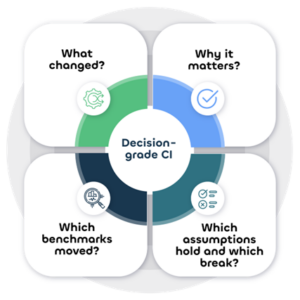
Competitive intelligence earns its value when it protects decisions from avoidable uncertainty. That happens when early signals with high predictive value are captured, validated, and interpreted in context, then translated into decision-ready benchmarks for development, partnering, and portfolio choices. In practice, strong pharmaceutical competitive intelligence reads like a decision brief:
What changed ➔ Why it matters ➔ What it implies ➔ Which assumptions it supports or breaks ➔ What is the best course of action
If your team has a decision coming up and needs a clearer view of the competitive bar, Scitaris can help. We support scenario-based CI built around the questions that matter in the moment, from indication selection and trial design through partner engagement, term shaping, and portfolio pivots.
Get in touch to discuss your competitive intelligence scenario.

Leonie Kohlhammer, PhD, is a senior consultant with a background in biochemistry, 3D imaging, and proteomics. After focusing on personalized healthcare during her M.Res. at Imperial College London, she pursued a translational cancer biology PhD at Barts Cancer Institute, Queen Mary University of London, and King’s College London. At Scitaris, she is supporting clients with triaging in-licensing opportunities, due diligence, and development strategy.

Kai-Hsin Cathie Chan, PhD, is a senior consultant with an expertise in biophysics and biochemistry. After graduating from National Taiwan University, she conducted her doctoral studies at the Max Planck Institute for Multidisciplinary Sciences (then the MPI for Biophysical Chemistry) in Goettingen, Germany. She then embarked on her career with Scitaris where she has advises clients on preclinical R&D, clinical trial design, portfolio strategy, and fundraising.